
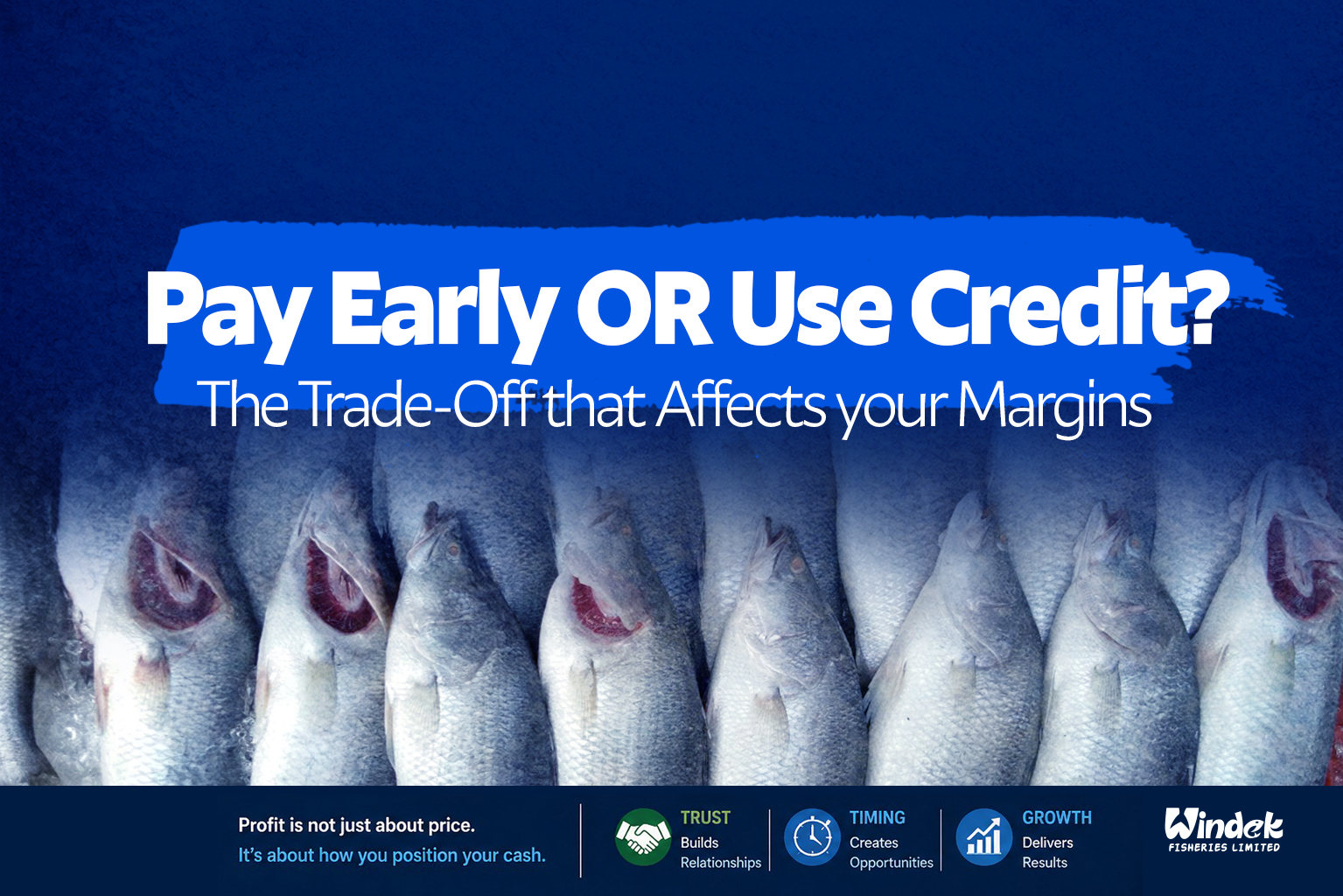
In fish trading, one decision quietly affects profitability more than most people realize:
Should you pay early or use credit?
At first glance, the answer seems simple.
Paying early feels safe.
Using credit feels risky.
But in reality, both approaches serve different purposes, and choosing the wrong one at the wrong time can limit growth or reduce margins.
A Common Scenario in the Market
Two buyers approach the same opportunity.
One pays early, secures stock, and keeps the transaction simple.
The other uses structured credit, keeps cash available, and buys more volume when needed.
Weeks later, the market shifts.
Prices move. Demand changes.
The outcome between the two buyers is often very different.
Not because one is smarter.
But because they made different financial decisions.

What Paying Early Actually Does
Paying early is often associated with discipline and reliability.
It offers several advantages:
-
Builds stronger supplier trust
-
Improves access to stock
-
Simplifies transactions
-
Reduces financial pressure
In many cases, suppliers prefer buyers who pay early because it reduces uncertainty.
When Paying Early Makes Sense
-
When building or strengthening supplier relationships
-
When securing priority during limited supply
-
When minimizing financial risk is the goal
Paying early creates stability.
The Hidden Limitation of Paying Early
Despite its benefits, paying early has a cost that is often overlooked.
Once payment is made:
-
Cash is no longer available
-
Flexibility is reduced
-
Opportunities may be missed
For example:
-
If prices drop after you’ve paid, you cannot easily buy more
-
If demand increases, your ability to scale quickly is limited
The cost is not visible immediately.
But it shows up in missed timing advantages.
What Using Credit Actually Does
Credit allows you to operate differently.
Instead of locking your cash, it gives you room to move.
Benefits of Using Credit
-
Keeps liquidity available
-
Allows larger or more frequent purchases
-
Aligns payment with actual sales cycles
-
Improves responsiveness to market changes
In a dynamic market like seafood, timing can significantly impact profitability.
Credit enables you to act when opportunities arise.
The Risk of Using Credit Incorrectly
The biggest misconception is that credit itself is the risk.
The real risk is unstructured credit.
When credit lacks clear terms:
-
Payment timelines become uncertain
-
Supplier confidence weakens
-
Future supply becomes unstable
Organizations like the International Finance Corporation emphasize that structured financing systems improve business performance across supply chains.
What Structured Credit Looks Like
-
Defined repayment timelines
-
Alignment with sales cycles
-
Clear communication between buyer and supplier
With structure, credit becomes predictable and manageable.
Cash vs Credit: A Strategic Perspective
The most successful fish traders do not rely on one method alone.
They use both, depending on the situation.
Use Cash When:
-
You want to build trust quickly
-
You need transaction simplicity
-
Market conditions are uncertain
Use Credit When:
-
Timing is critical
-
Opportunities require fast action
-
You want to scale beyond available cash
This approach creates balance between control and flexibility.
A Simple Decision Framework
Before deciding, ask:
-
Is this a relationship decision or a market opportunity?
-
Do I need liquidity or priority right now?
-
What is likely to happen in the next few weeks?
These questions help align your payment strategy with market conditions.
Why This Matters in Nigeria’s Seafood Market
Nigeria’s seafood market is influenced by:
-
Import cycles
-
Exchange rate fluctuations
-
Supply availability
-
Demand surges
In such an environment, timing plays a major role.
Relying only on cash can limit growth.
Relying only on credit can increase risk.
The advantage comes from knowing when to use each.
A Practical Way to Think About It
Cash builds trust.
Credit creates opportunity.
Both are necessary for long-term success.
Conclusion
The question is not whether to pay early or use credit.
The real question is:
What does the situation require right now?
Paying early strengthens relationships and reduces risk.
Using credit, when structured properly, improves flexibility and positioning.
The most successful businesses are not choosing one over the other.
They are using both strategically.
Internal Links
-
Services: https://windekfisheries.com/services/
-
Products: https://windekfisheries.com/products/
External Authority Reference
-
International Finance Corporation – https://www.ifc.org

Leave A Comment