
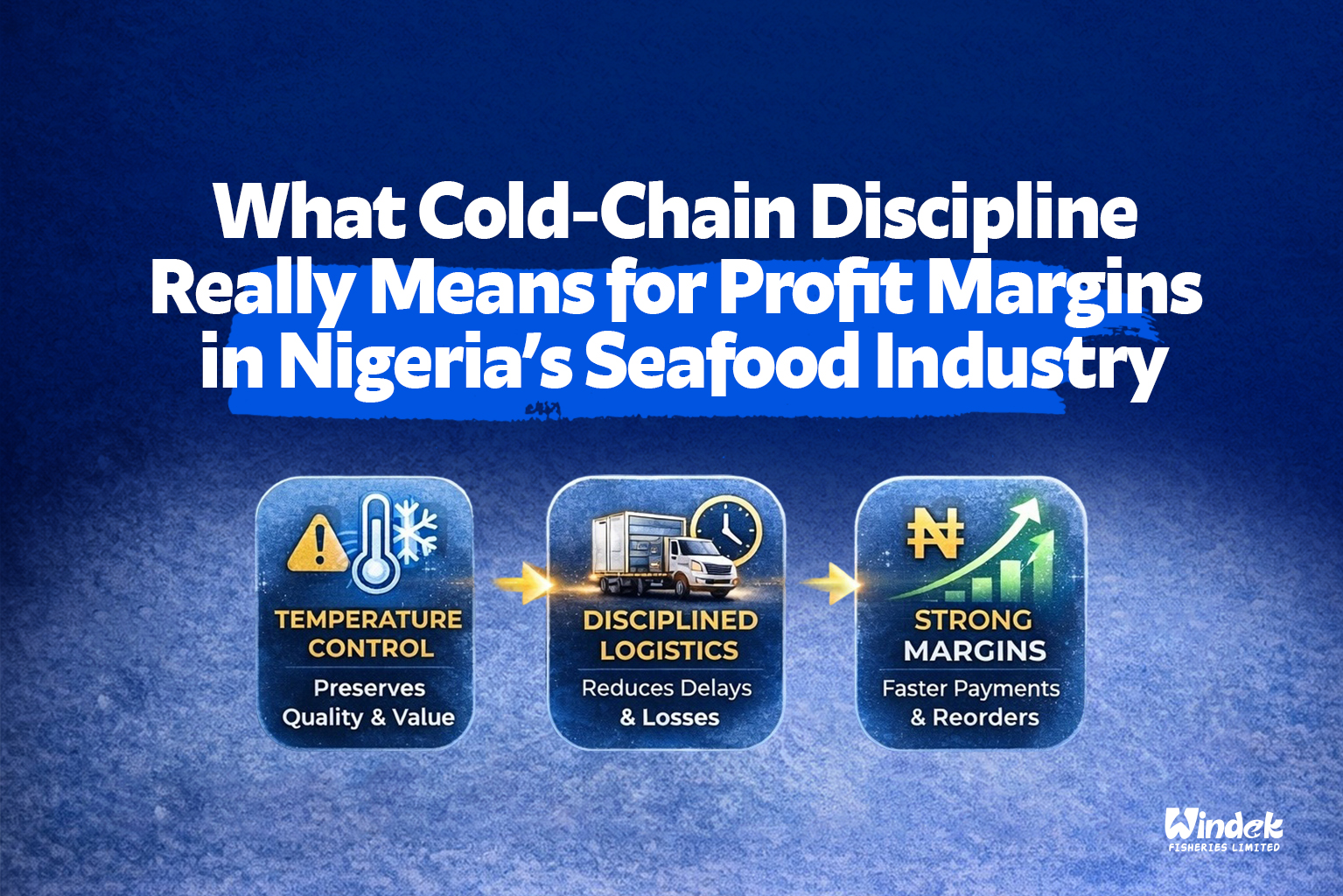
In Nigeria’s seafood industry, profit margins are not only determined by pricing or demand — they are largely controlled by one operational factor: cold-chain discipline.
From the moment fish is harvested or imported to the point it reaches the final buyer, temperature consistency determines quality, safety, and ultimately revenue. A break in the cold chain does not just affect freshness — it directly impacts profitability.
At Windek Fisheries Limited, we understand that cold-chain discipline is not a technical detail. It is infrastructure.
What Is Cold-Chain Discipline?
Cold-chain discipline refers to maintaining strict, uninterrupted temperature control across every stage of the seafood supply chain:
-
Processing
-
Storage
-
Transportation
-
Distribution
-
Retail handling
According to the Food and Agriculture Organization (FAO), post-harvest fish losses in developing countries can reach 20–30%, largely due to inadequate cold storage and poor handling practices.
Source:
FAO – Global Food Losses and Food Waste
https://www.fao.org/3/i2697e/i2697e.pdf
In practical terms, every temperature fluctuation increases:
-
Spoilage risk
-
Product dehydration (freezer burn)
-
Bacterial growth
-
Customer complaints
-
Revenue leakage
The Direct Link Between Cold Chain and Profit Margins
1. Reduced Product Loss
The FAO estimates that up to 35% of fish losses in Sub-Saharan Africa occur during handling, storage, and transportation.
Source:
FAO Fisheries & Aquaculture
https://www.fao.org/fishery/en
For seafood distributors, this translates into:
-
Lower sellable inventory
-
Increased write-offs
-
Emergency discounting
Cold-chain discipline protects sellable stock — and every percentage saved is direct margin preserved.
2. Stable Pricing Power
Buyers pay premium prices for seafood that:
-
Maintains texture
-
Preserves taste
-
Shows no thaw-refreeze damage
Inconsistent storage conditions reduce product grade, forcing sellers to compete on price rather than quality.
In competitive markets like Port Harcourt and other major Nigerian distribution hubs, pricing power depends on reliability.
3. Operational Efficiency
Disciplined cold-chain systems reduce:
-
Power wastage
-
Generator overuse
-
Emergency logistics costs
-
Unplanned inventory losses
According to the International Institute of Refrigeration (IIR), proper cold-chain management can reduce food losses by 15–20% globally.
Source:
International Institute of Refrigeration
https://iifiir.org/en
For seafood businesses, this is not theoretical — it is operational math.

The Nigerian Context
Nigeria remains one of Africa’s largest fish importers. According to FAO trade data, the country imports hundreds of thousands of metric tons of frozen fish annually to meet demand.
Source:
FAOSTAT Trade Data
https://www.fao.org/faostat/en/#data/TM
In high-volume import markets, cold-chain failure does not just affect individual businesses — it disrupts supply reliability across the ecosystem.
For buyers, it means inconsistent supply.
For suppliers, it means unpredictable revenue.
Cold-chain discipline becomes a competitive advantage.
What Cold-Chain Discipline Looks Like in Practice
It includes:
-
Verified freezer temperature monitoring
-
Properly insulated storage facilities
-
Structured inventory rotation (FIFO)
-
Controlled loading and offloading processes
-
Reliable cold transport systems
It is not simply owning cold rooms. It is operating them with precision.
Why This Matters for Buyers and Suppliers
If you are a supplier, disciplined cold-chain systems protect your brand and reduce return risk.
If you are a buyer, they guarantee product integrity, stable supply, and predictable quality.
In a market where margins are often tight, discipline becomes profitability.
The Windek Fisheries Approach
At Windek Fisheries Limited, cold-chain management is built into our operational framework.
We focus on:
-
Structured storage systems
-
Controlled product handling
-
Consistent temperature discipline
-
Reliable distribution planning
To learn more about our operations:
-
Explore our Home Page – https://windekfisheries.com/
-
Discover our Services – https://windekfisheries.com/services/
-
View our Products – https://windekfisheries.com/products/
Conclusion
Cold-chain discipline is not optional infrastructure in Nigeria’s seafood industry. It is profit protection.
In a supply-driven market where quality determines pricing and reliability determines partnerships, the businesses that treat cold-chain management as a core strategy — not a background function — are the ones that scale sustainably.
If the seafood industry is to reduce losses, protect margins, and improve food security, cold-chain discipline must move from conversation to execution.
External Authority Sources
-
FAO – Global Food Losses and Food Waste
https://www.fao.org/3/i2697e/i2697e.pdf -
FAO Fisheries & Aquaculture
https://www.fao.org/fishery/en -
FAOSTAT Trade Data
https://www.fao.org/faostat/en/#data/TM -
International Institute of Refrigeration
https://iifiir.org/en
Leave A Comment