
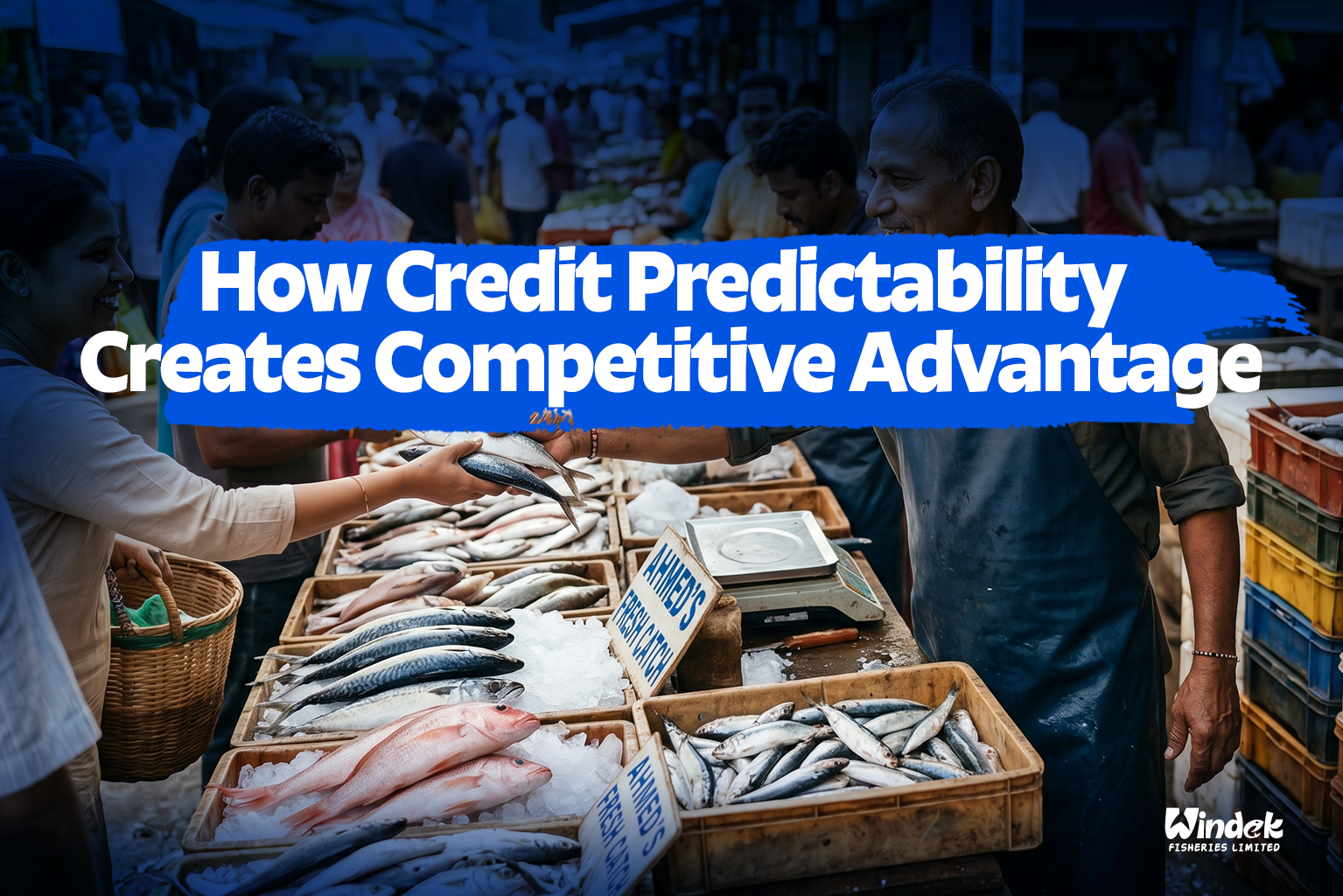
How Credit Predictability Creates Competitive Advantage
Most business conversations about credit focus on one thing:
Access.
Can you get credit?
How much credit can you get?
What are the repayment terms?
While these questions matter, they overlook something even more important:
Predictability.
Because in business, uncertainty is expensive.
The ability to reliably plan around financing often creates a bigger competitive advantage than access to financing itself.
The Difference Between Access and Predictability
Many businesses have access to some form of credit.
But access alone does not guarantee confidence.
Consider two fish traders.
Both have similar credit facilities.
One never knows whether credit approvals will be delayed, terms will change, or limits will be adjusted.
The other understands exactly how their financing works and can confidently plan around it.
Which trader is more likely to make better decisions?
The answer is obvious.
Predictability improves decision-making.

Why Predictability Matters in Fish Trading
The seafood market moves quickly.
Prices change.
Supply fluctuates.
Demand rises and falls.
Businesses that can predict their financing position are often able to:
-
Purchase inventory earlier
-
Respond faster to opportunities
-
Manage stock levels efficiently
-
Plan growth with confidence
Meanwhile, businesses operating under uncertainty often hesitate.
And hesitation can be costly.
The Hidden Cost of Financing Uncertainty
When financing is unpredictable, several problems emerge:
Delayed Purchasing Decisions
Businesses postpone buying decisions while waiting for financing clarity.
Missed Market Opportunities
Price drops and supply opportunities may pass before action can be taken.
Inventory Planning Challenges
Uncertainty makes it difficult to maintain optimal stock levels.
Slower Business Growth
Expansion plans often remain on hold when financing cannot be reliably forecasted.
None of these challenges appear immediately on financial statements.
Yet over time, they significantly affect competitiveness.
How Predictable Credit Improves Business Performance
Reliable credit creates operational confidence.
Businesses can:
Plan Ahead
Future purchases become easier to schedule.
Improve Cash Flow Management
Payment cycles can be aligned more effectively with sales cycles.
Strengthen Supplier Relationships
Predictable financing supports predictable payments.
Capture Opportunities Faster
Businesses can move quickly when favourable market conditions emerge.
In competitive markets, speed often creates advantage.
Why Predictability Creates Competitive Advantage
Competitive advantage is often associated with:
-
Larger capital
-
Bigger facilities
-
Greater market share
However, many successful businesses gain an advantage through something simpler:
Certainty.
When management knows what financial resources will be available, strategic decisions become easier.
Instead of reacting to uncertainty, businesses can proactively position themselves for growth.
The Role of Structured Credit
Organizations such as the International Finance Corporation consistently highlight access to reliable financing as a key driver of business growth and supply chain efficiency.
The goal should not simply be obtaining credit.
The goal should be building financing structures that are predictable and aligned with business operations.
When that happens, credit becomes a planning tool rather than merely a funding source.
A Practical Way to Think About It
Access to credit helps businesses operate.
Predictable credit helps businesses plan.
And businesses that plan better often outperform businesses that simply react.
Conclusion
In fish trading, success is rarely determined by access to opportunities alone.
It is determined by the ability to act when opportunities appear.
Credit predictability provides that ability.
It improves planning, reduces hesitation, and creates confidence across the business.
Over time, those advantages compound.
And that is how predictability becomes a competitive advantage.
Internal Links
-
Services: https://windekfisheries.com/services/
-
Products: https://windekfisheries.com/products/
External References
-
International Finance Corporation – https://www.ifc.org
-
Food and Agriculture Organization of the United Nations – https://www.fao.org

Leave A Comment