
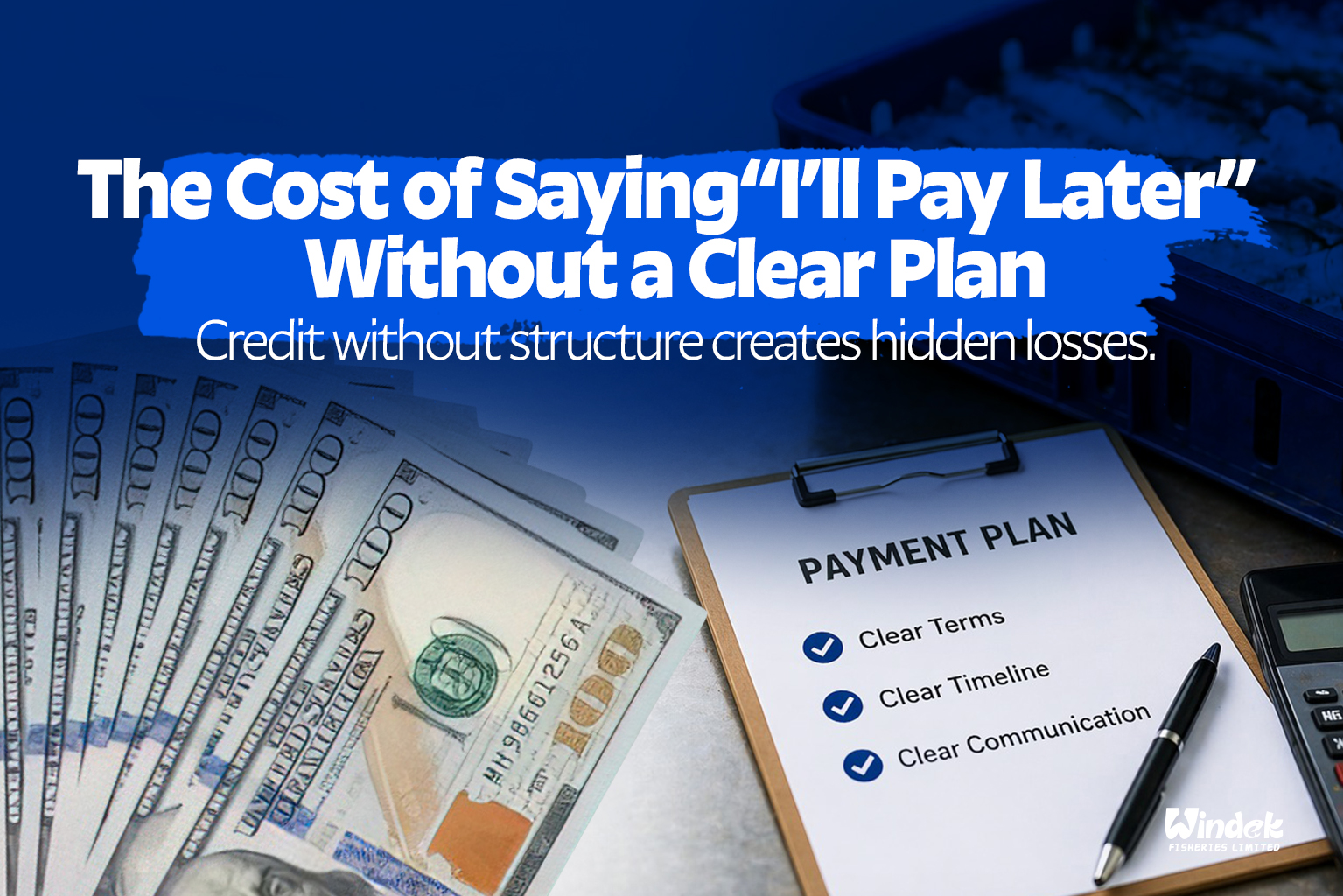
“I’ll pay later.”
It sounds simple. Flexible. Convenient.
In many fish trading relationships, this phrase is common. It often reflects trust between buyers and suppliers.
But over time, it can become one of the most expensive decisions a business makes.
Not because credit is bad.
But because credit without a clear plan creates hidden costs.
Where It Begins
In the early stages, everything works.
Stock moves. Sales happen.
There is mutual understanding.
Payment is expected later, but:
-
No exact timeline is defined
-
No structure is agreed
-
No alignment with actual sales cycles exists
At this point, the arrangement feels easy.
But the risk is already building.

When “Later” Becomes a Problem
As the business operates, small pressures begin to appear:
-
Sales fluctuate
-
Cash flow becomes uneven
-
Expenses compete for available funds
Without a defined payment plan, “later” becomes uncertain.
And uncertainty is where problems begin.
The Real Issue Is Not Credit
It is important to be clear:
Credit itself is not the problem.
In fact, across global value chains, organizations like the International Finance Corporation highlight structured financing as a key driver of business growth.
The real issue is unstructured credit.
When there is no clarity:
-
Payment timelines become unclear
-
Supplier confidence reduces
-
Future supply becomes unstable
The Hidden Costs of Unstructured Credit
These costs are rarely recorded as direct losses.
Instead, they appear gradually:
-
Payment delays create tension
-
Suppliers reduce supply or become cautious
-
Buying opportunities are missed
-
Relationships weaken over time
Nothing fails immediately.
But efficiency drops and growth slows.
The Ripple Effect on Your Business
One unclear credit arrangement affects more than a single transaction.
It impacts:
-
Your ability to restock consistently
-
Your credibility with suppliers
-
Your negotiating power
-
Your access to future credit
In a market where timing is critical, these limitations reduce competitiveness.
Why Structure Changes Everything
When credit is structured properly, outcomes improve significantly.
Structure introduces:
-
Defined payment timelines
-
Alignment with actual sales cycles
-
Clear communication between both parties
With these in place:
-
Pressure reduces
-
Planning improves
-
Trust becomes predictable
Credit becomes a system, not a source of stress.
A Practical Way to Think About It
Credit should not be based on assumption.
It should be based on agreement.
A simple principle:
If you cannot define when you will pay,
you will eventually struggle with how to pay.
Why This Matters in Nigeria’s Seafood Market
In Nigeria’s seafood market, where supply cycles, pricing, and demand can shift quickly, structured credit plays a critical role.
It allows businesses to:
-
Maintain steady supply
-
Manage cash flow effectively
-
Build long-term supplier relationships
Without structure, even profitable businesses can experience instability.
Conclusion
“I’ll pay later” may sound harmless.
But without a clear plan, it creates hidden costs that affect:
-
Profitability
-
Relationships
-
Growth potential
The businesses that succeed are not just those with access to credit.
They are the ones that use credit with structure and discipline.
Internal Links
-
Services: https://windekfisheries.com/services/
-
Products: https://windekfisheries.com/products/
External Authority Reference
-
International Finance Corporation – https://www.ifc.org

Leave A Comment