
In seafood distribution, losses are not always obvious.
They do not always come from bad purchases or poor pricing decisions.
Most of the time, they happen quietly.
Fish does not lose value suddenly.
It loses value gradually, often unnoticed.
By the time the problem becomes visible, the margin is already gone.
Understanding how this happens is critical for anyone involved in frozen fish supply, storage, or distribution.
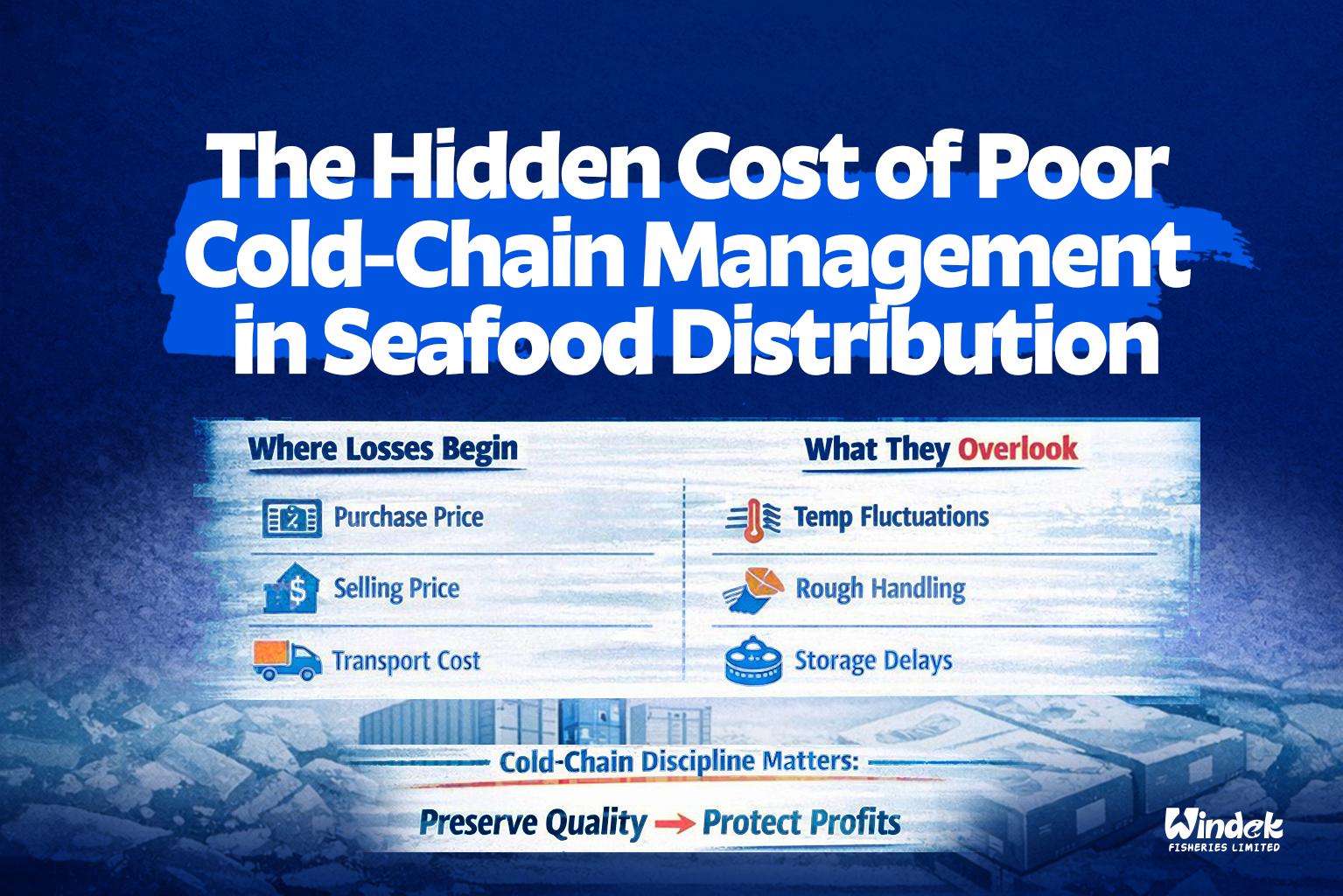
What Most Businesses Track
In a typical seafood transaction, attention is focused on:
-
Purchase price
-
Selling price
-
Transport cost
These are visible, measurable, and easy to monitor.
But they are not where most losses begin.

What Often Gets Overlooked
The real pressure on margins often comes from operational details:
-
Temperature consistency
-
Handling discipline
-
Storage timing
These factors are less visible, but far more impactful over time.
Across global food systems, organizations like the Food and Agriculture Organization of the United Nations have consistently highlighted cold-chain inefficiencies as a major cause of food loss, particularly in perishable products like fish.
Where Value Starts to Leak
Losses in seafood distribution rarely come from a single major failure.
They come from small, repeated breaks in the system:
-
A few extra hours before proper freezing
-
Inconsistent temperature during transport
-
Frequent cold room opening
-
Delays at offloading points
Individually, these may seem minor.
Collectively, they reduce product quality and market value.
This is a key challenge across many supply chains, especially in emerging markets where infrastructure gaps still exist.
What It Looks Like in Real Terms
Poor cold-chain management does not always result in visible spoilage.
Instead, it shows up in subtle ways:
-
Fish appears slightly softer
-
Shelf life becomes shorter
-
Buyers negotiate more aggressively
-
Stock takes longer to sell
-
Discounts become more frequent
Nothing dramatic.
Just steady pressure on margin.
The Cost That Is Rarely Calculated
One of the biggest challenges is that these losses are not always recorded as direct expenses.
They appear indirectly as:
-
Lower selling prices
-
Reduced repeat purchases
-
Faster spoilage cycles
-
Increased operational stress
According to insights from the International Finance Corporation, inefficiencies in handling and storage significantly affect profitability across agricultural value chains.
The cost is real.
But it compounds quietly over time.
The Difference Cold-Chain Discipline Makes
When cold-chain systems are properly managed, the results are clear:
-
Product quality is preserved
-
Pricing remains stronger
-
Sales cycles become more predictable
-
Buyer confidence increases
The product itself does not change.
The system around it does.
And that makes all the difference.
A Practical Way to Think About It
Price determines how you enter the market.
Cold-chain discipline determines how you exit it.
Why This Matters in Nigeria’s Seafood Market
In Nigeria, where seafood demand is high and distribution conditions can be challenging, maintaining strong cold-chain systems is even more critical.
Efficient handling, storage, and logistics directly impact profitability and long-term business sustainability.
Businesses that invest in operational discipline are better positioned to:
-
Reduce losses
-
Maintain product value
-
Build stronger buyer relationships
Conclusion
In seafood distribution, not all losses are visible.
Some happen before the sale.
Some happen during handling.
Most are only felt at the margin.
The businesses that grow are not just those that buy well.
They are the ones that preserve value throughout the entire supply chain.
Internal Linking Strategy
To strengthen SEO and improve navigation, connect this post to:
-
Home Page – https://windekfisheries.com/
-
Services Page – https://windekfisheries.com/services/
-
Products Page – https://windekfisheries.com/products/
External Authority Links
-
Food and Agriculture Organization of the United Nations – https://www.fao.org
-
International Finance Corporation – https://www.ifc.org

Leave A Comment