
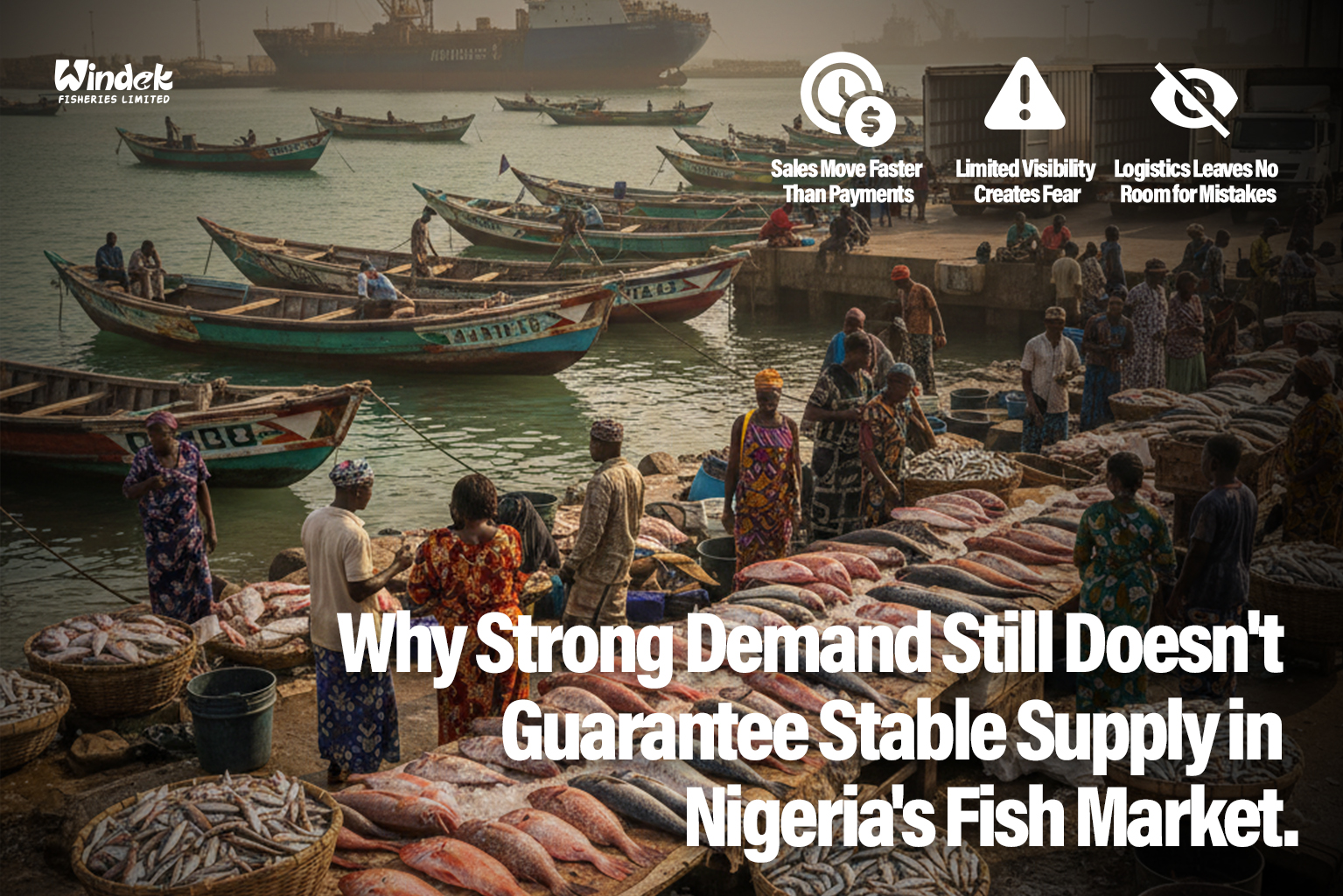
Nigeria’s fish market is growing.
Consumption continues to rise. Urban markets are active. Restaurants, retailers, and wholesalers move volume daily.
Yet supply instability remains one of the biggest challenges in the Nigerian seafood industry.
If demand is strong, why does supply still break down?
The answer lies in infrastructure, cold-chain discipline, and operational structure.
Nigeria’s Fish Demand Is Rising — But Supply Gaps Persist
Nigeria consumes over 3.6 million metric tons of fish annually, while domestic production falls significantly short of national demand.
According to the Food and Agriculture Organization of the United Nations, developing markets experience 20–30% post-harvest losses in perishable food sectors due to inadequate storage, handling, and logistics systems.
This means even when buyers are ready, product flow is not always stable.
Demand alone does not create reliability.
The Real Reasons Supply Becomes Unstable
1. Payment Timing vs. Sales Cycle
Fish may sell within days or weeks, yet many supply structures expect immediate settlement. When cash flow cycles are misaligned, pressure builds across the value chain.
Over time, this reduces flexibility and limits volume growth.
2. Weak Cold-Chain Infrastructure
Frozen fish is highly temperature-sensitive. Even short disruptions in storage or transportation can reduce quality and market value.
Cold-chain inefficiencies contribute directly to:
-
Product rejection
-
Price reductions
-
Spoilage losses
-
Delayed settlements
Without disciplined cold storage systems, strong demand cannot translate into stable supply.
3. Limited Visibility Across Inventory Movement
When suppliers lack real-time visibility into product flow, uncertainty increases.
Uncertainty leads to:
-
Reduced order volumes
-
Tighter credit terms
-
Lower trust levels
-
Conservative expansion
Stable markets require transparent systems.
Why Infrastructure Matters More Than Market Activity
Nigeria’s seafood industry is not struggling because buyers are missing.
It is struggling because systems are not fully optimized to protect product value from port to warehouse to market.
Reliable supply requires:
-
Structured cold storage
-
Disciplined logistics handling
-
Clear inventory tracking
-
Payment cycles aligned with real sales velocity
Businesses that invest in these areas experience lower losses and stronger long-term growth.
How Windek Fisheries Approaches Supply Stability
At Windek Fisheries Limited, we treat cold-chain management and operational discipline as core infrastructure — not an afterthought.
Our structured approach focuses on:
-
Temperature-controlled storage
-
Reliable frozen fish distribution
-
Inventory visibility
-
Predictable operational systems
You can learn more about our operations on our Home page, explore our structured logistics under Services, and review our frozen seafood categories on our Products page.
Stable supply is not accidental.
It is engineered.
Final Thoughts: Demand Needs Structure
Nigeria’s fish market will continue to grow.
Population expansion, urbanization, and changing consumption patterns ensure ongoing demand.
But growth without structure leads to volatility.
Strong demand creates opportunity.
Strong systems create stability.
The businesses that win long term will not be those with the most buyers —
They will be those with the strongest operational backbone.

Leave A Comment